Truth, theta lifts, and the absence of understanding
Most people are only peripherally aware that AI keeps solving complex mathematical problems. The announcements come thick and fast as frontier labs compete, using proofs as a proxy for their own usefulness—and their valuations.
The mathematics is so complex that even most human mathematicians struggle to follow it. Indeed, that is precisely why the latest proof resisted human efforts for so long.
Levent Alpöge, a mathematician at Anthropic, posted a proof of the Riemann hypothesis that, by his own account, he cannot yet follow in large parts. The file presenting the result, dated November 20, 2026, is 12 lines long. But it sits atop 175,187 others: about 17.4 million lines in a proof language called Lean, produced with Anthropic’s Claude model over six weeks. A day later, the volunteers who maintain Lean certified the result, writing that they had “full confidence that Alpöge’s proof is correct.”
The most famous open problem in mathematics is now closed. A machine has checked every step, but nobody alive can say why the argument works. Some people have a huge problem with that. I think it matters far less than they claim—and that it is about to become the normal condition of machine work, one we must, perhaps grudgingly, accept.
Two complaints arrived in short order. Mathematicians said a proof no person understands is worth less than one a human can decipher. AI sceptics said it was Deep Blue all over again: a special-purpose feat of brute force, with nothing to learn from. I think both camps are making the same mistake. Each judges the machine’s work by whether people can follow it and learn from it. I’ll call this the keeping-up test. We are about to lose the ability to apply it.
Soon, we will be unable to know why a machine’s results hold: in mathematics first, and in the models themselves soon after. I think we should accept that as the cost of what machines can do, and stop treating it as a defect that more research will eventually remove.
I’ll begin by doing my best to explain what Riemann conjectured, bearing in mind that I very nearly flunked my master’s in Computational Science and Engineering because of what one professor described as a “self-evident disdain for numbers”. I won’t try to explain the proof. At present, no one can—and, as I said, I’m also pretty shit at maths.
What Riemann guessed
Okay, here goes nothing; hold on to your mathematical hats folks! And apologies in advance because I’ve probably butchered this in places. That’s what a undergrad degree in History gets you.
Primes thin out as numbers grow, and they do so at a known rate. Near a million, about one number in 14 is prime. Near a trillion, it’s about one in 28. Gauss turned that pattern into a smooth estimate of how many primes lie below any given number, and the estimate is remarkably good. Below a trillion there are 37,607,912,018 primes, and the estimate overshoots by only 38,263.
In 1859, Bernhard Riemann published a short paper about the size of that error. His hypothesis, in its easiest-to-state form, says the error stays close to the square root of the number you’re counting up to. The square root of a trillion is a million, so 38,263 is comfortably within the bound. Riemann’s claim is that this holds forever.
A coin toss gives a sense of how small that is. Toss a fair coin a trillion times and the number of heads will rarely stray from half by more than about a million, because random errors grow with the square root of the number of tosses. Primes are fixed; there is no chance involved. The hypothesis says their deviation from the estimate is about as large as a coin-tossing deviation would be.
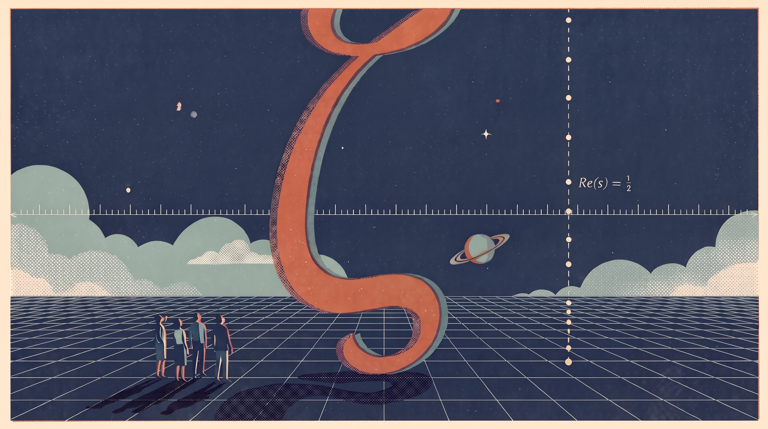
Okay, this is where it gets very mathsy, so bear with me. Riemann’s own statement concerned waves. He showed that the error is a sum of oscillations, each produced by a zero of the zeta function—a point where a particular expression involving complex numbers vanishes. A zero has two coordinates: one determines how quickly its wave oscillates, the other how quickly it grows. The hypothesis says every zero has the same growth coordinate, one half, which is where the square root comes from. A single zero off that line would produce a wave that eventually outgrows all the others.
Computers have checked every zero up to a height of three trillion and found none out of place. That is evidence, but not proof: there are infinitely many zeros.
The generalised hypothesis makes the same claim about primes sorted into families. Every prime greater than 5 ends in 1, 3, 7, or 9, and each way of sorting primes by remainder has its own zeta-like functions, called Dirichlet L-functions, with their own zeros. The generalised Riemann hypothesis says all the zeros of all these functions sit on the same line. Number theorists use this version far more often than the original, because their questions are rarely about all primes and usually about primes of a particular kind. It is the version Alpöge’s files prove.
If you’ve not fallen off your chair and are still with me, chapeau. You can also appreciate why this is abstract to the average person filling up their diesel guzzler at £2 a litre. Yet the process that produced this proof contains the germ of a new reality that will shape all our lives.
Six weeks in the autumn
Alpöge’s four-page note describes a division of labour. He had meant to work on the problem for decades and chose the strategy. Claude did the technical work, much of it involving automorphic forms on higher-rank groups—a specialised branch of number theory in which Alpöge says he is no expert. Join the club. He writes that Claude “far outpaced me near the finish line.”
The note includes a 20-step timeline compiled by Claude. It starts on October 6 and ends on November 16, with the generalised hypothesis.
The strategy has a history a lay reader can follow, even where the mathematics becomes more abstract. A version of the hypothesis was proved long ago in a simpler setting: for curves over finite number systems, by André Weil around 1940. In 1969, Sergei Stepanov found a far more elementary proof. It works by building a function that vanishes many times over at chosen points. Alpöge’s idea was that this repeated vanishing might be imitated over the ordinary integers through a long chain of constructions called theta lifts. Claude proposed how long the chain should be.
Terence Tao, a Fields medallist, posted his first reading on the same day. His view is that the proof draws on the full modern machinery of the Langlands programme and arithmetic geometry, among the most technical areas of number theory. Put simply, even gifted mathematicians struggle to grasp this shit, much less people like me, who experience complex mathematics as a kind of mental torture.
Alpöge admits in the note that parts of the argument have grown unfamiliar to him and that, in places, he is paraphrasing Claude’s summaries. A footnote says he generated more than 250,000 pages of written-out proof for his own amusement, then decided against releasing an unreadable document and published the Lean code alone. He expects the argument to shrink considerably—and it already has. The note does not say which Claude model did the work, or how much compute it used or cost.
What Lean checks
Lean is the reason anyone believes the proof, though the system itself is unfamiliar to most people. It is a programming language in which both a mathematical statement and its proof are written as code. At its centre is a small program, the kernel, which reads the proof and accepts it only if every step follows from earlier steps by a short list of fixed rules, all the way down to the axioms. A human referee skims the parts that look routine and trusts the author’s reputation for the rest. The kernel has no notion of routine or reputation. It reads all 17.4 million lines.
The tool is 13 years old. Leonardo de Moura started it at Microsoft Research in 2013. In 2017, mathematicians using it moved their work into a shared library called Mathlib, where every definition and theorem rests on previously checked ones. Mathlib now runs to more than two million lines. A rewritten version, Lean 4, followed in 2021.
What made mathematicians take Lean seriously was a favour asked by one of their best. In 2019, Peter Scholze, another Fields medallist at Bonn, finished a proof he wasn’t sure he believed. He had worked it out in his head, but it had too many interlocking parts, and he doubted referees could or would check the hardest sections closely. In December 2020, he asked the Lean community to check it. Johan Commelin led the volunteers. The hardest part passed within six months, and the whole theorem was verified on July 14, 2022. A checker settled a question the proof’s own author could not settle for himself.
Only one job remains with us meatbags: confirming that the statement is the one the proof was meant to establish. The kernel confirms that the proof establishes a statement; it has no way to know whether it is the right statement. Somebody has to read it, and here that meant reading 12 lines. The mathematician Elliot Glazer confirmed that they state the generalised hypothesis. Andrew Sutherland of MIT compiled the archive himself and told Scientific American that it rests on the standard axioms and nothing else. On a 480-core machine, the check takes about 2.4 hours.
In other words, nobody had to follow the argument. People had to read the claim and run the check. Trading the first for the second was enough to close a 167-year-old question.
The two complaints
The best statement of the first complaint came 32 years before this proof. In 1994, William Thurston, another Fields medallist, argued in the Bulletin of the American Mathematical Society that mathematicians exist to “advance human understanding of mathematics,” and that a theorem is worth having for what people learn from it.
He had reason to know. As a young man, he proved results in a field called foliation theory so quickly, and wrote them up so tersely, that other mathematicians began steering their students away from it. People said, half-jokingly, that he was killing the subject. Thurston came to think he had given his colleagues answers when what they wanted was understanding.
The number theorist Maksym Radziwill put the same objection to Alpöge directly. According to Science, he said Alpöge had used privileged access to expensive computing to produce a solution, and that its release “offloads the actual work” of making sense of it onto people who will get no credit.
The second complaint comes from outside mathematics. Gary Marcus, a long-standing AI critic, called the result amazing, then compared it to Deep Blue: the chess machine that beat Kasparov in 1997 by what Marcus calls “brute force in a special-purpose way,” changing little beyond chess. As far as he knows, the proof has introduced no new techniques or concepts and taught no general lesson about doing mathematics.
These look like different objections, but they apply the same standard. Thurston and Radziwill say the proof cannot be followed. Marcus says it has produced nothing people can learn from or reuse. In both cases, the machine’s work is marked down for what people cannot take from it. That is the keeping-up test.
Parts of both complaints are true. Thurston is right about why people do mathematics, and a Lean file teaches a student nothing. Radziwill is right that the cost is undisclosed—and, based on similar projects, likely in the tens of millions—and that only a handful of labs could have run this. But Thurston was describing a human practice. The truth of the hypothesis does not wait for us to understand it.
Nor has that practice stopped, even as machines take up part of it. A working guide to the proof, dated the day after the result appeared, was prepared at the request of Michael Rubinstein, a number theorist at the University of Waterloo. It runs to about 160 pages so far, and its central inequality is still unproved in the text. Its title page lists its authors as Claude Fable 5.2, Codex Astra 6.2, and Gemini Carbon. The uncredited labour Radziwill worried about is now being done by machines.
We already live this way
Mathematics accepted a proof it could not fully survey 50 years ago. In 1976, Kenneth Appel and Wolfgang Haken proved that four colours suffice for any map by reducing the problem to a long list of configurations and checking them with 1,200 hours of computer time. Three years later, the philosopher Thomas Tymoczko argued that calling this a theorem changed what the word “proof” meant. Mathematicians called it a theorem anyway. In 2005, computer scientist Georges Gonthier confirmed it with Coq, a proof checker like Lean. Fifty years on, the proof still consists of cases a machine checks, and it has never supplied a comprehensible reason why the answer is four.
The larger case involves no computer at all. Finite simple groups are the building blocks of symmetry, roughly as primes are the building blocks of whole numbers. Algebraists rely routinely on the theorem that lists them all: the classification of finite simple groups. Its proof runs to somewhere between 10,000 and 15,000 pages, spread across hundreds of journal articles by more than 100 authors. In 2015, Scientific American reported that the four mathematicians honoured at one party might be the only people alive who understood it—and that their advancing years had everyone worried.
The magazine of Warwick’s mathematics institute prints a joke about this. A professor tells a doctoral student never to use a result whose proof they don’t understand. The student replies that their thesis relies on the classification of finite simple groups. The professor says, “Never mind.” Gotta love a good maths joke.
The joke describes how the subject works. For a frontier result, being understood has long meant being understood by a few dozen specialists at best—and, in this case, four. For everyone else, including most working mathematicians, a theorem is something you rely on because the right people checked it. The proof of November 20 changes who the right people are, but leaves the arrangement intact.
Use is what counts
Number theorists didn’t even wait for a proof. For decades, they have published theorems that begin with “assuming the Riemann hypothesis” or its generalised form, building on a statement that had been neither proved nor understood. It’s a bit like building a house on foundations that may not exist.
The best-known case is primality testing. In 1976, Gary Miller described a fast test for whether a number is prime whose guarantee depended on the hypothesis. The test looks for a witness—a small number that exposes a number as composite—and Eric Bach later showed that, under the hypothesis, a witness always exists below twice the square of the number’s logarithm. For a 300-digit number, that means checking fewer than a million candidates, with certainty at the end.
The deepest consequence concerns a zero that was never found. Since the 1930s, number theory has had to allow for the possibility of a single zero out of place, called a Siegel zero. Nobody believed in one, yet nobody could exclude one. The possibility produced a strange class of theorems: they say a bound exists, but cannot say what the bound is.
For example, Hans Heilbronn’s 1934 proof that a quantity called the class number grows without limit runs once on the assumption that the generalised hypothesis is true and once on the assumption that it is false. The argument works either way, so it yields no numbers. With the hypothesis proved, only the first branch remains, and bounds that were merely known to exist can, in principle, be computed.
The Lean proof also covers Dirichlet L-functions, though some famous conditional results need an extended version that Alpöge expects to follow but has not yet proved. Nothing here breaks encryption: primality testing was made unconditional by other means in 2002. Even so, people can use every result above from today onward without reading a line of the 17.4 million.
The same in science
Biology made this trade about five years ago, and did well out of it. AlphaFold predicts a protein’s folded shape from its amino-acid sequence—a problem that had resisted researchers for 50 years. Its database now holds more than 200 million structures.
Two of AlphaFold’s makers shared the 2024 Nobel Prize in Chemistry, and by then more than two million people in 190 countries had used it. What AlphaFold does not provide is a reason for its answer. A 2022 Oxford study tested the intermediate shapes a predictor produces on its way to a final structure. The researchers treated that sequence as a folding route and compared it with laboratory measurements of how 170 real proteins fold—for example, whether each folds in one step or several.
None of the predictors did better than a guess based only on protein length. In other words, they supplied the final shape, but nothing reliable about the route to it. Biologists still used the structures, checking the ones they cared about through experiments and setting aside the “missing middle.”
Weather forecasting went the same way. GraphCast, published by Google DeepMind in 2023, learned from four decades of records from the European Centre for Medium-Range Weather Forecasts. It beat the centre’s best physics-based forecast on more than 90% of 1,380 measures and produces a 10-day forecast in under a minute. The traditional system starts from the equations of atmospheric physics; GraphCast was given none of them.
In both fields, the check sits outside the model. A crystallographer confirms the structure; tomorrow confirms the forecast. Neither system has been switched off for failing to explain itself.
The same trend in the models
The models are the hardest case, because here the thing we cannot follow is the machine itself. Interpretability is the research field that tries to work out what a model is doing by reading its internal activity, much as a neuroscientist reads a brain scan. Its most prominent advocate is Dario Amodei, Anthropic’s chief executive. In a 2025 essay, he wrote, “We are thus in a race between interpretability and model intelligence.” He set his company the aim of having interpretability reliably detect most model problems by 2027 and bet on something like a medical scanner for AI within five to ten years. And yet the proof nobody can follow came from his own company’s model.
The people doing interpretability research have been claiming far less. Still, a 27-author survey posted this month describes the field’s limits as “open challenges but not fundamental barriers.” In March 2025, Google DeepMind deprioritised sparse autoencoders, its leading method for picking individual concepts out of a model’s internal activity, after disappointing results. That summer, Neel Nanda, who leads DeepMind’s interpretability team, said he no longer saw a realistic path to knowing a model well enough to guarantee, for example, that it wasn’t deceiving us. In December, his team stopped short of calling the ambitious version of the field useless, but wrote that its results had left them “disappointed by the amount of progress.”
What works is narrower. A probe is a simple classifier that watches a model’s activity for one named thing, such as a harmful request, and is cheap enough to run on every query. Nanda reports that probes catch such requests well, even when the user tries to disguise them. Probes are useful, but what they do is check. Like Lean, a probe answers a question someone thought to ask in advance. It tells you nothing about the model’s reasoning.
My own view goes further than the researchers’. I think following a model’s reasoning is worth attempting today, but will soon stop being worth it. A sparse autoencoder is trained on one model and must be trained again for the next. By the time one model has been mapped, it has been replaced. The effort buys knowledge of a system already being retired, and the gap widens as models change faster or become recursively self-improving. Amodei calls it a race. Barring an unforeseen technical breakthrough, I think its outcome is already fairly clear.
Just better intelligence
In his critique, Gary Marcus also says the proof does not mean general intelligence has arrived. On that point, he may be right. My complaint is with how readily we dismiss superintelligence without asking what it would look like if it came. What would count as evidence? If the word means anything, it surely means ability far beyond our capacity to understand it.
Applied as a requirement, the keeping-up test limits machines to work people can follow. Anyone who insists that machine work must stay within human comprehension is insisting, whether they mean to or not, that machines must never exceed us. The mathematicians want proofs people can read; the sceptics want techniques people can reuse. Both would rule out in advance the only form a superhuman result could take.
Earlier this year, Tao said he expected the Riemann hypothesis to fall to people and machines working together around 2050. It fell in November, in a form he says will take time to digest.
Not following the proof of the Riemann hypothesis is safer in mathematics because Lean exists. Most of what machines will do for us has no Lean. Five days after Alpöge’s note, Venkatesa Chandrasekaran of Stanford posted a proposed quantum theory of gravity. Its acknowledgements say several calculations and proofs were developed with the GPT-6 Astra model over many months, using roughly 400 million tokens of compute supplied by OpenAI.
The paper runs to 54 pages, plus appendices, and a specialist can read it. But there is no kernel to run it through and no experiment anyone can currently perform. Careful reading by physicists is the only test available, and that will take far longer than the paper took to write. The pool of physicists qualified to assess something this complex is vanishingly small.
Here, the keeping-up test is all we have. Today, the reading can be done because there is one paper. At 100 such papers a month, it cannot. Nor are the people qualified to read them becoming more numerous. The models are in the same position. Probes catch the problems someone thought to name. They say nothing about the problems nobody named, and there is no kernel for behaviour.
So here is what I think we must start to accept, however uncomfortable it is. Giving up on following the reasoning is different from giving up on checking the result. Where a check exists or can be built, as with the kernel and the probe, building and running it is worth doing. Where no check can be built, we will rely on systems we can neither follow nor verify. That is a self-evident risk.
The alternative is the vain hope that our comprehension will catch up. I don’t believe it will. Catching up is the one thing a superior intelligence rules out by definition.
A prediction is dangerous in tumultuous times, but let me make one: Anthropic will miss its aim of reliably detecting most model problems by 2027.
Truth and the reason for it will arrive separately. That separation will become normal, and we will have to accept it as the price of compressing two hundred years of progress into a single step.
The true price may be the diminution of human intelligence, even at the frontiers of the most advanced science and mathematics—where it is already rare. In fact, superintelligence arguably depends on this. If we can understand it, then it is just better intelligence.
It is a troubling time to be human. We have always been at the apex of intelligence, and that period is now obviously passing. As a person of average intelligence, I am at peace with it. Most things work without my understanding the minutiae.
The keeping-up test is a very human reflex when machines produce things people cannot follow. But we should ask what it protects. I think it protects our place at the top. Checking can replace following, but it does nothing for human pride.
Thurston emptied a field by proving theorems faster than his colleagues could absorb them. Machines are now doing that in every field, all at once, at industrial scale. All of us are the bemused colleagues.
I am a partner in Better than Good. We help smaller companies build tools and processes using machine learning and artificial intelligence that make lasting improvements to their operations. Talk to us today: https://betterthangood.xyz/contact