The Digital Restoration Paradox: Why 1950s Film Stock Beats 2000s Cutting-Edge Technology
In the late 1990s and early 2000s, a wave of filmmakers made what seemed like an obvious choice. Film stock was expensive, temperamental, required careful storage, and would eventually decay. Digital was immediate, endlessly copyable, and felt like the future. Why keep shooting on a format invented in the 1880s when you could embrace the new millennium properly?
Two decades later, those cutting-edge digital productions are now far harder to restore to modern standards than films shot on celluloid fifty years earlier. A well-preserved 35mm negative from 1955 can yield a gorgeous 4K transfer. A digital feature from 2003, shot on what was then state-of-the-art equipment, might be stuck at standard definition forever.
Days of Future Past
When Danny Boyle shot 28 Days Later in 2002, he chose Canon XL-1 miniDV cameras. The decision was partly practical as the lightweight cameras allowed for guerrilla-style shooting on London’s deserted streets, and partly aesthetic. The harsh, blown-out digital look gave the film an immediacy that felt perfect for a story about civilisation’s collapse.
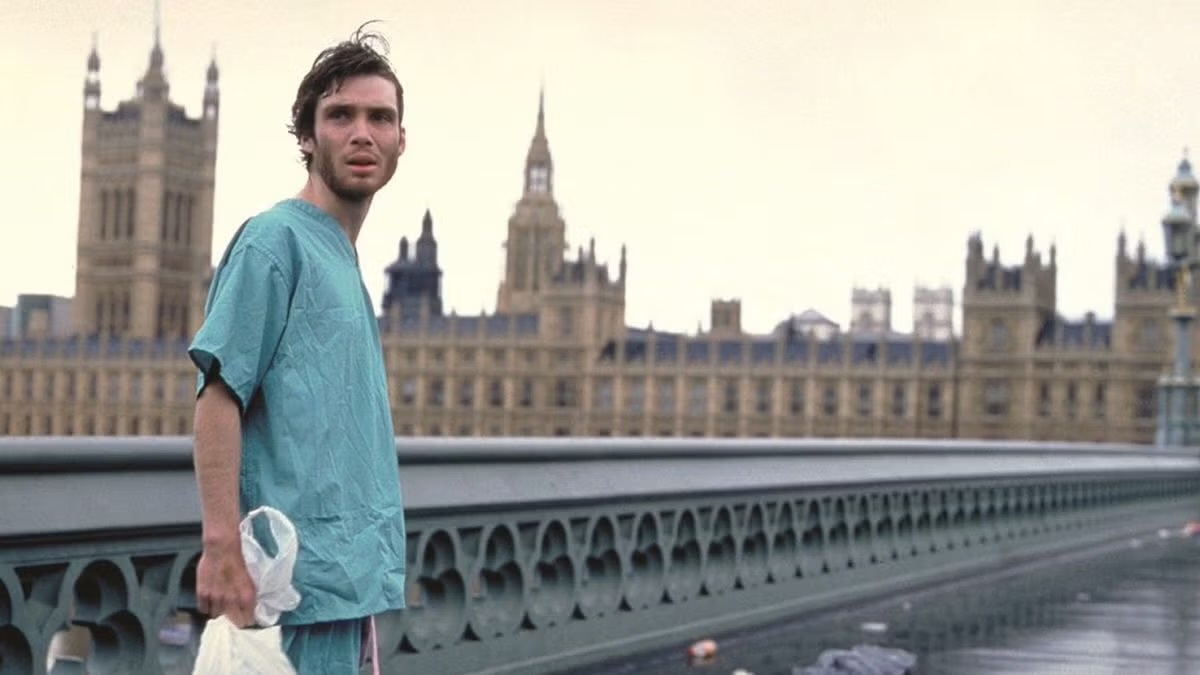
The cameras recorded at 720×576 pixels which is PAL standard definition. For context, a modern iPhone shoots 4K video at 3840×2160 pixels, with roughly 25 times more information in every frame.
At the time, this didn’t seem like a problem. Standard definition was the norm. DVDs looked fantastic compared to VHS. Nobody was thinking about what these films would look like in twenty years.
In contrast, when you shoot on 35mm film, the main standard for movie cameras, you’re not really capturing a fixed resolution. You’re exposing silver halide crystals to light, creating a physical record of the scene with an almost absurd amount of potential detail. The exact “resolution” depends on the film stock and how you scan it, but modern estimates put 35mm somewhere between 4K and 8K equivalent. Some argue even higher for large format stock such as 80mm.
More importantly, that detail actually exists in the negative. It’s been sitting there since the day the film was shot, waiting for scanning technology to catch up. When we remaster Lawrence of Arabia or 2001: A Space Odyssey in 4K, we’re not inventing detail. We’re finally extracting what was always there.
Digital video from the early 2000s doesn’t work that way. What was captured is what exists. Those 720×576 pixels aren’t hiding secret information underneath. The cameras had a fixed resolution, and that resolution is now embarrassingly low by contemporary standards.
The Uncanny Valley of Upscaling
“But wait,” you might reasonably ask, “can’t we just use AI to upscale these films?”
We can. And increasingly, we do. Tools have become remarkably sophisticated at adding plausible detail to low-resolution footage. The results can be impressive, especially for content that wasn’t intended to look “cinematic” in the first place such as old TV shows, news footage and home videos.
The problem is that word. Plausible. AI upscaling doesn’t reveal hidden details. It hallucinates detail that looks like it could have been there. The algorithm examines a blocky, pixelated face and generates what a higher-resolution version of that face might look like based on patterns it learned from millions of other faces.
Sometimes this works brilliantly. Sometimes you get something that sits in a weird uncanny valley, technically sharper but somehow wrong in ways that are hard to articulate. Textures that feel synthetic, skin that looks waxy and fabric that doesn’t quite behave like fabric.
For films that were shot on early digital for aesthetic reasons, aggressive AI processing creates an additional problem. The lo-fi digital texture of 28 Days Later isn’t a flaw to be corrected, it’s part of what made the movie work. Clean it up too much and you lose something that can’t be put back.
This puts restoration teams in an impossible position. Do you present the film as it was intended to be seen, knowing modern audiences on 65-inch 4K screens will notice every compression artifact? Or do you “improve” it with AI, knowing you’re changing the director’s original vision at its core.
A Brief History of Bad Timing
The 2000s were uniquely cursed in this regard. It was the precise moment when digital filmmaking became viable enough that serious directors started using it, but before the technology had matured to resolutions that would remain acceptable long-term.
Consider the timeline.
Late 1990s — Digital video exists but is mostly confined to low-budget indie films and documentaries. The Dogme 95 movement embraces the format’s limitations as aesthetic virtues. Lars von Trier shoots The Celebration on miniDV in 1998.
2000–2002 — Early digital starts appearing in mainstream productions. George Lucas shoots Attack of the Clones on Sony CineAlta cameras at 1080p, declaring it the future of cinema. Boyle shoots 28 Days Later on miniDV. The gates are opening.
2003–2006 — The wave crests. Michael Mann shoots Collateral and Miami Vice on Thompson Viper cameras. David Lynch makes Inland Empire on a Sony PD-150, declaring he’ll never shoot film again. Robert Rodriguez pushes digital filmmaking into family blockbusters with Spy Kids sequels and Sin City.
2007–2010 — The first truly high-resolution digital cinema cameras appear. The Red One launches in 2007, capable of shooting at 4K. The Arri Alexa follows in 2010. From this point forward, digital films generally capture enough resolution to survive future format changes (subject to future radical changes to screen technology).
That roughly seven-year window, let’s call it 2000 to 2007, is a generation of films that were technologically progressive for their time and are now technologically trapped.
Some of the most visually distinctive work of the era lives in this limbo. Inland Empire’s hallucinatory nightmare textures were inseparable from the crude DV format Lynch used. Dancer in the Dark’s raw emotional brutality came partly from being shot on 100 consumer camcorders simultaneously. Open Water’s horror worked because it felt like you were watching somebody’s holiday video turn into a snuff film.
George Lucas enters, stage right
Attack of the Clones (2002) was the first major studio production shot entirely on digital cameras. Lucas had been pushing for this transition for years, convinced that digital was not only the future but actively superior to film.
The Sony CineAlta cameras used for Episodes II and III captured at 1080p. By the standards of 2002, this was impressive, true high definition when most consumers were still watching standard def broadcasts. By current standards, it’s less than a quarter of 4K resolution and roughly a sixteenth of 8K.
4K releases of the prequel trilogy exist, but they’re heavily upscaled rather than derived from native high-resolution sources. Watch them on a large modern display and you’ll notice a certain softness, a lack of the crystalline detail present in the original trilogy restorations (which were shot on film and could be properly scanned at 4K).
The irony here is that Lucas was so convinced of digital’s superiority that he also went back and “improved” the original trilogy with digital effects, effects that were rendered at resolutions that now look dated while the underlying film footage remains timeless.
Why Film Ages Better Than Files
A film negative is a physical object that can be re-examined with improving technology. Better scanners extract more detail. Better colour science improves the transfer. The negative hasn’t changed, but our ability to read it has.
A digital file is a fixed quantity. The numbers in the file are the numbers in the file. You can process them differently, upscale them algorithmically, but you can’t extract information that was never captured.
There’s also the question of format obsolescence. Film is remarkably stable as a storage medium. A properly stored negative from 1920 can still be projected or scanned today using the same principles as when it was created. The format hasn’t changed because the format is physical.
Digital formats change constantly. Codecs fall out of favour. Compression standards evolve and storage media become unreadable. A miniDV tape from 2003 requires increasingly rare hardware to play. A hard drive from the same era might be entirely dead. The theoretical advantages of digital, perfect copying, no degradation, only matter if you can actually access the data.
There are documented cases of studios discovering that digital masters from the early 2000s had become corrupted or were stored in formats nobody could easily read anymore. The Library of Congress has warned repeatedly about the challenges of digital preservation compared to traditional film archiving.
This doesn’t mean film is some perfect archival medium. It absolutely isn’t. Celluloid degrades. Colour stocks from the 1970s and 80s are notorious for fading toward magenta. Nitrate film from the silent era is literally flammable and chemically unstable. Acetate stock can develop “vinegar syndrome,” becoming brittle and unusable. Countless films have been lost because negatives were stored poorly, damaged in fires, or simply thrown away when studios decided they had no commercial value.
The point isn’t that film preservation is easy. It’s that when a film negative is properly preserved (stored at controlled temperature and humidity, protected from light and chemical contamination) the information embedded in those silver halide crystals remains accessible. The ceiling for recovery is remarkably high, even if reaching that ceiling requires considerable effort and expense.
What Happens Now?
Studios and distributors are increasingly turning to AI-powered restoration for early digital films, with mixed results.
The 4K release of something like Collateral is the best-case scenario. The film was shot at 1080p, but the imagery was carefully composed and the digital artifacts were minimal. AI upscaling can add convincing detail without changing the viewing experience at its core. It’s not quite the same as a native 4K source, but it’s acceptable.
At the other end of the spectrum, a film like Inland Empire probably shouldn’t be “restored” in any traditional sense. The blown-out highlights, crushed blacks, and compression artifacts aren’t problems to be solved. They’re part of the film’s visual language. Any version that removes them would be a different movie. Most early digital films fall somewhere between these extremes, requiring case-by-case decisions about how much intervention is appropriate.
A Note on What We’ve Lost
The films shot on early digital aren’t obscure curiosities. They include some of the most culturally important work of their era. 28 Days Later all but invented the modern zombie movie. Inland Empire is Lynch at his most experimental. Collateral is Mann’s masterpiece. The Star Wars prequels, whatever your feelings about them, were childhood-defining for a generation.
These films exist, and will continue to exist, in some form. But the question of how they’ll look to future audiences remains unresolved. Will AI upscaling become convincing enough that the resolution limitations become invisible? Will tastes shift so that early digital aesthetic becomes valued rather than apologised for? Will someone invent restoration techniques we can’t currently imagine?
In Praise of Uncertainty
Early digital films aren’t going to disappear. They’ll be preserved, restored with whatever tools are available, and watched by future audiences who will bring their own expectations and tolerances to the experience.
But there’s something worth recognising about the people who chose digital in the early 2000s, often because it seemed like the responsible, forward-thinking choice. They were wrong in ways they couldn’t have anticipated.
The filmmakers who stuck with “outdated” 35mm through this period, often facing pressure and mockery for their technological conservatism, turned out to be the ones preserving their work most reliably for the future.
Christopher Nolan’s stubborn insistence on shooting film, which seemed almost pathologically nostalgic at the time, now looks prescient. His films from this era scan beautifully at 4K and will continue to scale up as display technology improves. His digital-pioneering contemporaries are stuck trying to make 1080p footage look acceptable on increasingly massive screens.
There’s no triumphalism in pointing this out. Just a reminder that the future is harder to predict than it looks, and the technologies that feel inevitable sometimes turn out to be evolutionary dead ends.
The early digital era produced remarkable films that pushed the medium in directions film stock couldn’t go. Those films deserve to be seen and remembered. But the format that made them possible also trapped them in amber at resolutions that grow more limiting every year.
I am a partner in Better than Good. We help smaller companies build tools and processes using machine learning and artificial intelligence that make lasting improvements to their operations. Talk to us today: https://betterthangood.xyz/contact