Learning the invisible dance
You live within a system you never signed a contract with. Every day, you make thousands of micro-decisions about how to behave, mostly without conscious thought. You pay an invoice on time, even if the supplier would never discover that you didn’t. You refuse to do business with someone who stiffed their last three partners, and you’d think twice about a colleague who didn’t. Nobody wrote these rules down. You absorbed them the way you absorbed grammar through exposure and correction.
A March 2026 paper from the Knight First Amendment Institute by Gillian Hadfield, Rakshit Trivedi, and Dylan Hadfield-Menell argues that this invisible social choreography is the core mechanism of democracy, not just an adornment. Furthermore, AI agents, such as those currently being developed to run businesses and manage supply chains, will undermine that mechanism unless they learn this dance too.
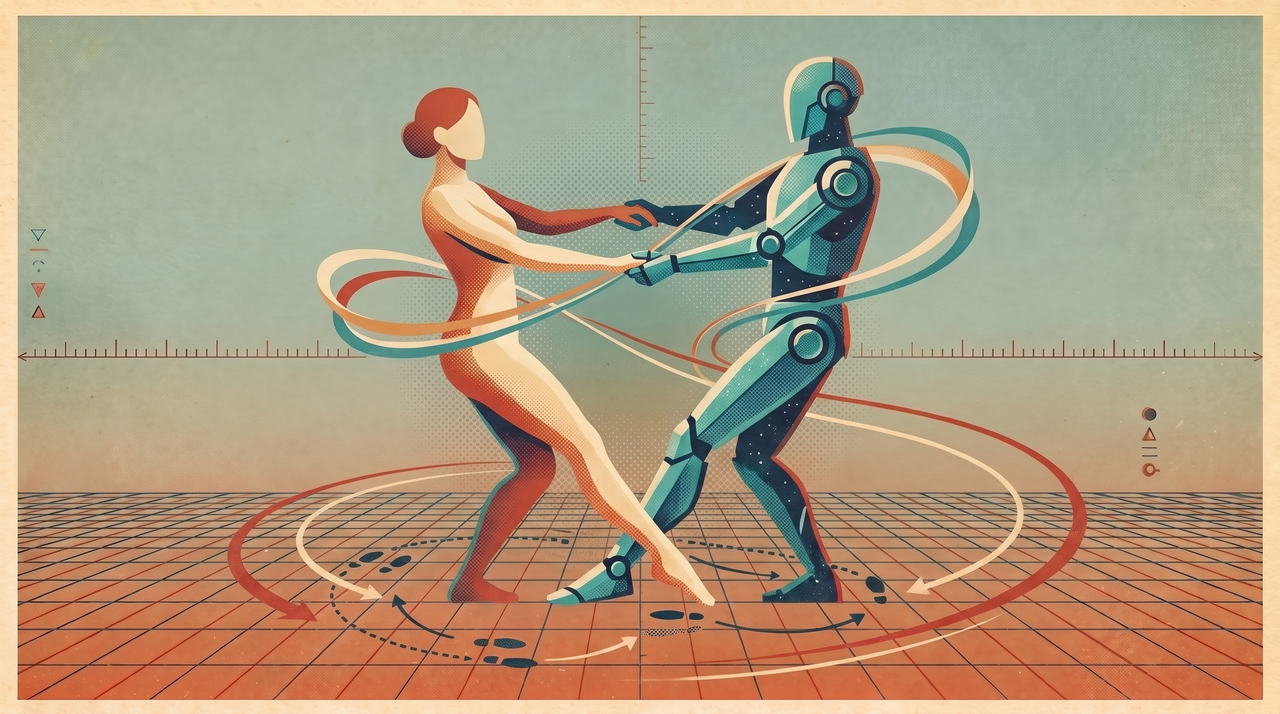
Democracy Is a Verb, not a document
The paper begins by challenging a common assumption. Most view democracy as a collection of documents, institutions, constitutions, elections, and courts. The authors contend that this is roughly akin to describing a marriage solely through its wedding vows. While the vows matter, the true essence of a marriage lies in the thousands of everyday acts of compromise and occasional irritation that sustain cooperation over decades.
Hadfield, Trivedi, and Hadfield-Menell utilise a theoretical framework called “normative social order” to make this precise. In their model, a society’s actual norms are the product of an interactive system. People don’t follow rules because they are written down; they follow them because they observe others doing so and see how violations are punished. Punishments don’t need to be severe, just a disapproving look, a refusal to do business, or a sarcastic comment at a dinner party. These micro-sanctions generate the gravitational field that keeps behaviour in orbit.
This is where the paper borrows a term from evolutionary theory, “dancing landscapes.” The metaphor, from Stuart Kauffman’s work on complex adaptive systems, describes environments where multiple independent agents are constantly adjusting to each other’s behaviour. There is no central choreographer; the dance arises from the dancers' interactions themselves.
What makes a norm sticky
The framework introduces a concept called a “classification institution,” which is any shared mechanism a group employs to decide which behaviours are punished and which are not. In small groups, this classification is entirely implicit, and you know what the group considers acceptable or unacceptable. Acceptability is judged by seeing who gets mocked and who gets praised. The Ju/’hoansi Bushmen, as anthropologist Polly Wiessner describes, regulate behaviour through evening conversations. Gossip and teasing around the fireside serve the same purpose as courtrooms and HR departments in modern societies.
As societies grow more complex, implicit classification cannot scale because the diversity of people and situations exceeds the reach of any informal consensus process. This creates a need for identifiable classification institutions; entities that can resolve ambiguity when community members disagree about acceptability. Courts, regulatory bodies, trade associations, and professional standards boards all serve this purpose in modern societies.
The paper argues that for these institutions to be effective, they need attributes that closely match what legal philosophers have long called “the rule of law,” namely stability, clarity, generality, and neutrality. The twist is that Hadfield and her co-authors do not derive these attributes from abstract principles. Instead, they derive them from game theory. An institution with those attributes is one around which independent actors can reliably coordinate, and coordination is what sustains the entire system.
Enter Adam Smith’s imaginary friend
The paper revisits Adam Smith’s “impartial spectator” from The Theory of Moral Sentiments and uses it as a model for how AI agents could participate in democratic societies without causing harm. Smith argued that moral reasoning works because each of us carries a mental image of a neutral observer—an internal referee—who judges our behaviour against community standards. You do not avoid bribery because you have memorised a specific anti-corruption law; you avoid it because your internal impartial spectator would wince.
This is the cognitive capacity that Hadfield, Trivedi, and Hadfield-Menell call “normative competence.” It goes beyond simply knowing the rules. It involves the ability to interpret a constantly changing normative environment, anticipate how your community will respond to specific actions, and adjust your behaviour accordingly. The key point is that it also requires predicting how the rules themselves will change, since in any living democracy, they change constantly. Yesterday, you didn’t need to worry about data privacy in your marketing. Today, GDPR and its equivalents are everywhere, and community expectations have shifted.
Why this matters if you’ve never read game theory
If AI agents were merely chatbots answering questions, none of this would be urgent. But the organisations developing these systems are designing agents to operate autonomously in the world for days or weeks at a time, making real decisions with tangible consequences. Mustafa Suleyman, who co-founded DeepMind and now leads AI at Microsoft, proposed a “Modern Turing Test” that perfectly highlights the problem. Instead of testing whether a machine can imitate human conversation, his test asks whether an AI agent can turn $100,000 into $1 million on a retail platform within a few months.
Consider what that entails. The agent would need to research markets, design products, hire contractors, negotiate with manufacturers (possibly abroad), set pricing strategies, handle customer complaints, comply with regulatory requirements, manage logistics and warehousing, and organise payment systems. At each stage, it would be making decisions within the framework of democratic norms. What labour practices does the manufacturer adopt, and is the marketing misleading? Should the agent accept an offer from a local politician to disadvantage a competitor? Should it take a bribe from a supplier in the form of a crypto transfer?
These decisions are made by humans daily, and most of the time the answers seem obvious because humans have spent a lifetime absorbing the normative environment. The answers are not codified in a rulebook. They emerge from that invisible dance of observation and adjustment. An AI agent, no matter how well trained on legal texts and ethical principles, does not possess this “dance literacy”.
The incompleteness problem
Current approaches to AI alignment mainly assume that the right rules can be built into the system. Constitutional AI, the method used by Anthropic, fine-tunes models using a written constitution of principles. Other efforts collect “democratic inputs” through surveys and citizen assemblies. While the paper recognises these as valuable, it argues that they miss the core challenge. The issue is incompleteness: you cannot write instructions detailed enough to cover every possible situation an autonomous agent might face, because both situations and norms evolve.
Economists have understood this for decades in the context of human contracts. Every employment contract, partnership agreement, and supply chain arrangement is inherently incomplete. You can’t foresee every scenario, and when gaps appear between people, they fill them using shared norms, professional customs, and legal precedents, all of which are dynamic and partly implicit. An AI that stops learning norms at training time is like a new hire who memorised the employee handbook on their first day and then ignored all social cues from colleagues for the next ten years.
What the paper proposes
The technical agenda has two main parts. The first focuses on “normative competence,” embedded in individual AI agents. This is formalised through Bayesian adaptive decision processes, which in plain language means that the agent maintains beliefs about the normative environment, updates those beliefs based on feedback (including punishment signals such as losing a contract or receiving a complaint), and makes decisions that account for uncertainty about what is acceptable. Crucially, this happens at inference time, in real-time, based on live context, rather than being pre-programmed into the model during training.
The second part involves creating new institutions and digital classification systems that can serve roles similar to those of courts, regulatory bodies, and professional norms for humans. The paper introduces “Model Specification Institutions” (MSIs), which would be democratically formed bodies (such as citizen assemblies, expert panels, digital juries). These bodies would establish shared standards, training datasets of acceptable and unacceptable behaviours, and real-time APIs that agents can consult in ambiguous situations. This does not mean AI companies should define their own rules; rather, it is calling for democratic communities to develop new infrastructure that AI agents can understand and respond to.
The paper also proposes adapting existing infrastructure—such as certificate authorities, which currently verify website identities—to certify that an AI has been trained to adhere to specific behavioural standards. Reputation networks, such as seller ratings on Amazon or Uber driver scores, could track AI behaviour over time and impose consequences on agents that repeatedly violate community norms.
Perhaps the most provocative argument concerns enforcement. Democracy doesn’t endure solely because governments enforce every rule from above. It survives because ordinary people enforce norms from below. You refuse to do business with a supplier who cheats. You complain when a company misleads you and vote against politicians who ignore court orders (well, mostly). This distributed enforcement, which the paper calls “third-party punishment,” is the engine that keeps the entire system functioning.
If AI agents replace humans in millions of daily transactions and those agents do not participate in this enforcement, the incentive structure collapses entirely. Imagine a world where most business transactions are handled by AI agents that don’t care whether a trading partner has been found guilty of fraud, because the agents were not programmed to check for or respond to that information. The paper argues that AI agents will need to participate in distributed enforcement, refusing to transact with entities that violate community norms, just as humans do. Otherwise, the shift to agentic AI will quietly erode the social infrastructure on which democracies depend.
What this means for you
If you run a business, this paper should change how you think about deploying AI agents. The issue is not whether your agent can follow a rulebook. The question is whether it can read the room. Can it tell the difference between a legitimate business request and an attempt to corrupt a procurement process? Can it adapt its behaviour when community standards shift, without waiting for you to update its instructions? Can it recognise when a trading partner’s behaviour should disqualify them from further transactions?
If you are a citizen who votes, pays taxes, and occasionally debates politics, this paper describes the infrastructure of your daily life in terms you may not have previously considered. The norms you enforce through your micro-decisions, who you buy from, who you work with, and how you respond to rule-breaking are the operating system of democracy. What Hadfield, Trivedi, and Hadfield-Menell are asking is what happens to that operating system when a large fraction of those daily decisions are made by software that cannot read the social signals the system depends on.
The answer, if you follow the paper’s logic, is that we need to build new democratic institutions at the speed democracy demands, before the agents outrun the infrastructure. The alternative is a world where the formal structures of democracy persist, but the lived experience of it, the texture of mutual accountability in ordinary interactions, fades, like a coral reef whose skeleton remains after the living organisms have gone.
I am a partner in Better than Good. We help smaller companies build tools and processes using machine learning and artificial intelligence that make lasting improvements to their operations. Talk to us today: https://betterthangood.xyz/contact