Break it down, baby
Scott Hansen brought a dead machine back to life, and the first thing it played was Midnight in a Perfect World. The machine was a beige Akai MPC60 II, caked in grime, its screen blown, its floppy drive jammed, paint peeling. It had spent roughly twenty years in storage as junk. Hansen, who records ambient electronic music as Tycho, had been asked by DJ Shadow to help with data recovery for the 30th anniversary remaster of Endtroducing....., the 1996 album that the Guinness Book of Records recognises as the first ever composed entirely from samples.
Shadow arrived at Hansen's studio with hundreds of floppy disks and the original MPC that the album was made on. Hansen took one look at the machine, abandoned the data project, and spent weeks soaking parts in dish soap and solvents, replacing the screen, and rebuilding the unit from the chassis up. When Shadow loaded the first disk and hit play, the room heard the opening bars of a record that has sat on Rolling Stone's 500 Greatest Albums list for a quarter of a century, coming not from a pressing or a file but from the instrument that made it.
The moment was a window in time, but it was also, if you think about what was really happening, a warning. The album that proved digital sampling could produce work as deep as any live recording turns out to be among the most fragile things in the archive.
Thirteen seconds and a turntable
To understand what came off those disks, you need to understand what went onto them. Endtroducing..... was built between 1994 and 1996 on three pieces of equipment: an Akai MPC60 MKII sampler, a Technics SL-1200 turntable, and an Alesis ADAT eight-track tape recorder. Shadow worked first in his California apartment, then at the Glue Factory, the San Francisco home studio of Dan the Automator, whose contribution was largely leaving the room and letting Shadow get on with using his gear.
The MPC60 II was a Roger Linn design, released in 1991. It sampled at 12-bit and 40kHz, which is lower fidelity than CD (16-bit, 44.1kHz), but it gave the recorded sound a particular graininess that became part of the album's texture. Its total sample memory, with the expansion board fitted, was 26.2 seconds of mono audio. That number shaped many aspects of the record. At roughly 60 kilobytes per second, the machine's entire memory fits on a single floppy disk. You are not making a 63-minute album inside 26 seconds of RAM. You are making it in layers, and each layer consumes the last.
Shadow's workflow was a hand-rolled paging system with tape as the backing store. He would sample vinyl fragments into the MPC, chop them in the machine's trim mode, assign the chops across the 16 pads, and sequence a pass. When memory was full, he bounced the MPC's output to a stereo pair of tracks on the ADAT, which gave him eight tracks of 16-bit, 48kHz digital audio on S-VHS tape. Then he wiped the MPC's memory and started the next layer, synced to what was already on tape. “It was all about chopping,” Shadow told an interviewer in 1997. “I never had the luxury of taking extended samples. There are lots of overdubs on the album, as well. But the whole record was 100% sample-based, or vinyl-based. All the sampling was done on the MPC. It all went straight from turntable to the MPC to tape.”
Each bounce was a converter round trip and another generation of tape. It was also irreversible. Once two layers were on the same pair of ADAT tracks, they could not be separated again. The process was compositional: the record's structure emerged from the order in which layers were committed to tape, and every commitment destroyed the working state that came before it. When the ADAT tracks were full, the whole thing was mixed down to DAT at the studio, where it was, in Shadow's words, “maybe compressed and limited a little bit.” By the end, there was no multitrack of the album. There was only a mix.
Patchwork as an instrument
The bounce-and-wipe cycle was a production constraint. The compositional innovation was what happened inside each layer before the bounce. Shadow did not sample loops; he sampled fragments, often too short to be recognisable as their source, and rebuilt them into something that functioned as a new composition. A two-second drum hit became a texture, and a horn phrase became a pad. A spoken-word clip became rhythm. The MPC's trim mode let him define start and end points within a sample, chop it into discrete regions, and convert the resulting slices into a “program” mapped across the pads. He then played the pads percussively, and the sequence the MPC recorded was a performance of fragments rather than a loop.
The method was harder than it sounds, because turntable pitch control was part of it. Shadow would adjust the speed of a record on the SL-1200 to match its tempo to the track he was building, sample at the altered speed, and let the MPC's transposition handle the rest. But transposition on a 12-bit sampler is resampling, not pitch-shifting in the modern sense.
Pitch and timbre are coupled. Play a sample two semitones down, and it gets darker, not just lower. The album's warm, murky quality is partly this: the sound of vinyl, through a cheap phono stage, through a 12-bit converter, through transposition that changes timbre as it changes pitch, through the analogue output of the MPC, through a Mackie desk, onto tape. Every stage adds character and removes bandwidth, and the accumulation of those small degradations is the record's unique sound.
The sequencer ran at 96 parts per quarter note, which gives 24 ticks per sixteenth note. Roger Linn's swing function, which he invented for his original LM-1 drum machine in 1979 and carried into the MPC, delays the second sixteenth note within each eighth note by a variable amount. At 66%, you get perfect triplet swing. On a 96ppq grid, that is a whole-tick offset of 8 ticks on a step that is 24 ticks long. The feel people describe as the MPC's “magic timing” is integer arithmetic on a coarse clock. Modern sequencers running at 960 or 4,096ppq cannot land on those positions without explicitly emulating the rounding. The grid provides the groove.
The collector's disks
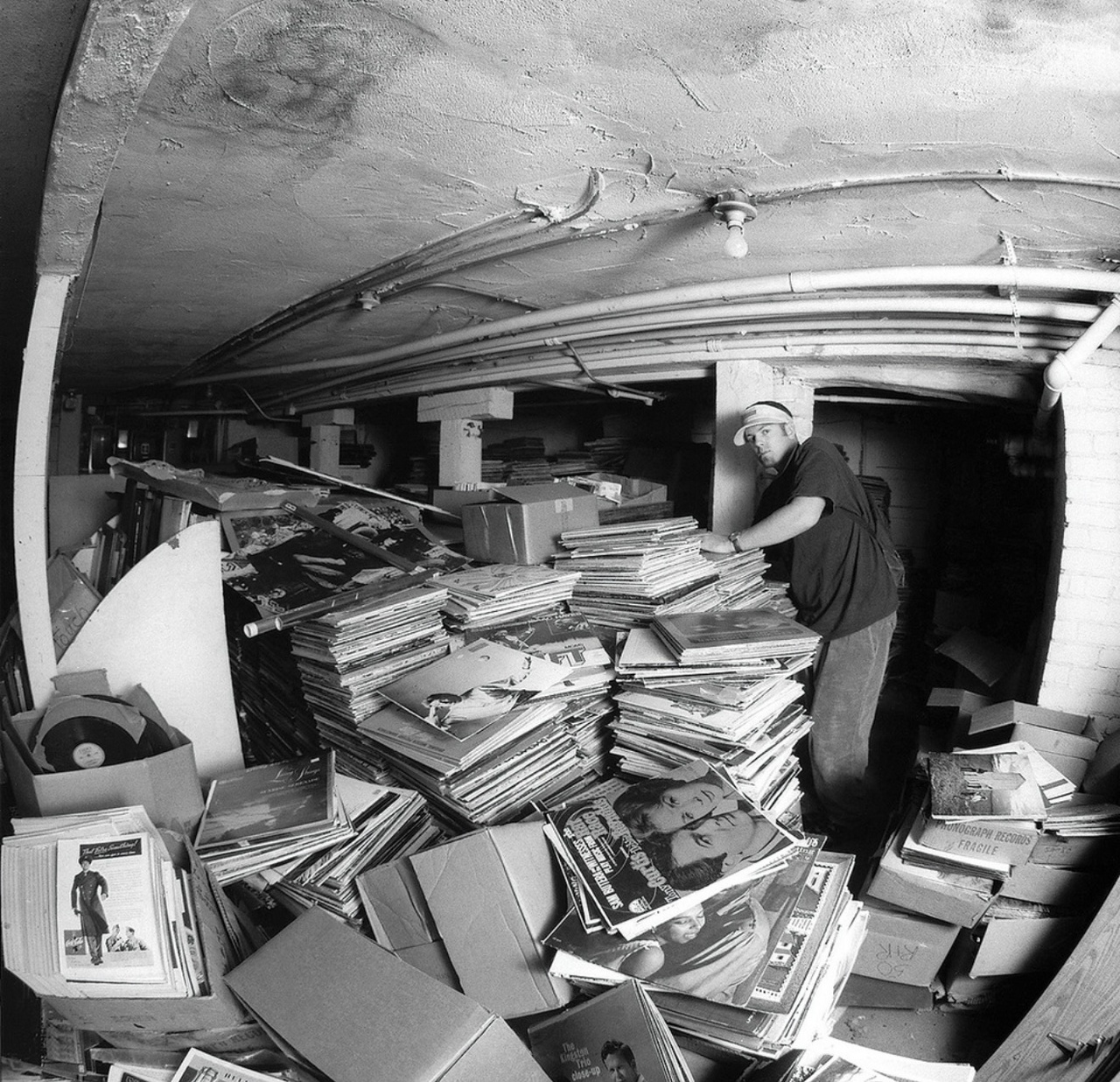
Shadow does not appear to be the kind of person who loses things. He has a personal record collection exceeding 60,000 vinyl records, accumulated over decades of systematic crate-digging at shops like Rare Records in Sacramento, where he spent hours each day in the basement. For Action Adventure in 2023, he bought 200 radio-broadcast tapes from eBay and worked through records in his own collection he had never previously listened to.
So when Hansen describes “huge cases of floppy disks, hundreds and hundreds of them,” that number is not hoarding; it is the arithmetic of production. At 793 kilobytes per MPC60-formatted disk, with the machine holding 26 seconds of audio at 40kHz, one disk is roughly a full memory load. Two years of production, with each session potentially generating multiple saves of sequences and sample data, produces hundreds of disks by definition. And given Shadow's temperament, those disks were very likely ordered, labelled, and stored deliberately.
The MPC60 saves two kinds of data to floppy: sequences (the MIDI-like performance data, the arrangement of chops on pads, the timing, the swing settings) and sound files (the actual 12-bit audio). A “set” in MPC terminology is a collection of sequences with their associated sounds and parameters. When Hansen says Shadow “pulled up one of the sets,” the machine loaded a set, and the set contained enough information to play back a track through the MPC's own sound engine and converters. What came out of the speakers was not a recording of Midnight in a Perfect World. It was a rendering. The machine was performing the track from its source data, thirty years after the last time.
Four things that can die
The MPC restoration project that Hansen undertook as part of the album remaster shows what digital preservation means when the format is proprietary, the reader is discontinued, and the knowledge is tacit.
Media. Thirty-year-old double-density 3.5-inch floppy disks. Magnetic media degrades. The MPC60 formats DS/DD media to its own 793K layout rather than the standard 720K, using 10 sectors per track instead of 9, at 512 bytes per sector, double-sided, 80 tracks. A standard USB floppy drive cannot read this format at all. If you plug the disks into a modern computer, you get nothing.
Format. The Akai filesystem sitting on those sectors is proprietary. Recovering the raw bytes is not enough. Someone has to parse the file structures, understand how sequences reference sounds by name, and reconstruct the relationships between programs, sounds, and the sequences that play them. A missing sound file is a dangling pointer; the sequence plays, but silently.
Hardware. The actual MPC60 II that Shadow used in 1994-1996 was found with a dead display, a jammed floppy drive, grime coating every surface, and paint flaking off the front panel. He tore it to the chassis, soaked the parts, sourced a replacement screen, and rebuilt it. Had he not, and had this particular machine been thrown away by whoever stored it, a period-correct rendering of the album's source data would require finding another MPC60 II, hoping its converters and output stage were within tolerance, and accepting that the result would not be precisely the same. The restored unit is exact, which means the sound coming out of it when Shadow hit play was not a reproduction. It was the exact same signal path from the exact same device.
Knowledge. Which disk holds which track. Which set is the final version and which is an abandoned take. What order the bounces went in. What was done on the desk. Eight-character filenames on a machine with a two-line LCD display. Shadow's own memory is presumably the index, and it is the one thing you cannot image to a backup.
When Shadow's Mo' Wax singles were remastered in 2025 for a box set, the original DAT tapes were in some cases so aged and fragile that multiple machines were needed to get a clean transfer. DAT is a robust format by comparison. It is standardised, widely supported, and transfers digitally. The MPC floppies are none of these things.
What a full reconstruction would mean
What follows is informed speculation about what the remaster might entail, based on a short interview with Hansen that was released on Shadow’s socials, the known architecture of the MPC60 II, and the documented production history of the album.
Imaging the disks is the first problem. Flux-level imaging using hardware like the KryoFlux or Greaseweazle captures the raw magnetic transitions on the disk surface rather than attempting to decode data in real time. This matters because a thirty-year-old disk with weak sectors might return errors on a conventional read but yield recoverable data from a flux capture, where the raw signal can be processed multiple times with different error-correction strategies. Cambridge University Library's “Copy That Floppy” preservation project uses exactly this approach for obsolete formats. The flux images are the archive. Everything else is derived from them.
The second problem is rendering. The MPC60 is not just a reader. It is the instrument. Its 12-bit converters, its analogue output stage, and its particular approach to sample playback are all part of what the album sounds like. An emulator could play back the sequences and trigger the sounds, but it would do so through modern conversion at modern bit depths, which is not the same signal.
The restored original machine solves this. Load the set, press play, and what comes out of the stereo outputs is the same electrical signal that came out in 1996, through the same converters and the same analogue path. Record that at high resolution and you have a stem, or at least a layer, rendered at period-correct fidelity.
This is the part that bends the mind slightly. The album, as released, has no multitrack. The bounce-and-wipe process destroyed the separation between layers as Shadow worked. The MPC floppies hold the material that existed before each bounce, the save states from a process that consumed its intermediates. If you can identify which sets correspond to which layers of which tracks, you can render each one in isolation through the restored machine and produce separated parts that have never existed at any point in the album's history, not even during production. You are not recovering a multitrack. You are compiling one for the first time.
There are limits, and they are not small. Turntable work performed live-to-tape during production is on the ADAT, not in the MPC data. Desk moves and outboard processing may be unrecorded. Some bounced layers may have no surviving pre-bounce source, because the corresponding disks were overwritten or lost. The reconstruction is therefore a hybrid: recovered sequence data rendered through period-correct hardware, layered with material that can only come off the ADAT tapes (if they survive) or be re-performed. A faithful reconstruction of Endtroducing..... is therefore a huge and complicated undertaking.
On December 18th, Shadow will perform Endtroducing..... live at the Barbican with the BBC Symphony Orchestra, conducted by Jules Buckley, in a one-off orchestral reimagining recorded for BBC 6 Music. You cannot orchestrate a stereo mix. You need separable parts, melodic lines, harmonic structures, rhythmic patterns, each isolated enough for a composer to write around them. The MPC reclamation project may be the reason that concert is possible at all.
The fragility of the first digital generation
There is a comforting myth about digital media, which is that it lasts forever because copying is lossless. The myth confuses the copy with the thing being copied. A bitwise duplicate of an MPC60 floppy disk image is perfect, if you have one. But the image is useless without a format specification, the format is useless without a reader, and the reader is useless without the tacit knowledge of what the data means. A 1968 analogue master tape can be baked in an oven to temporarily re-bind the oxide, threaded onto a compatible machine, and played. The format is the medium's physics. A 1994 Akai floppy needs reverse-engineered filesystem knowledge, bespoke imaging hardware, and a working machine that has been out of production for thirty years.
The first generation of digital-native creative work, the records made on MPCs and SP-1200s and Atari STs, the art made on Amigas and early Macs, the writing saved to 800K floppies in proprietary word-processor formats, is the most endangered material in the cultural archive. Not because the bits have decayed, though some have, but because the stack of dependencies between the bits and the meaning is deep, undocumented, and each layer can fail independently.
Hansen soaked MPC parts in dish soap to make a piece of music history audible again. That is both a beautiful story and a cautionary tale. The album that proved you could build something permanent from other people's forgotten records was itself perilously close to becoming unrecoverable. Digital is not the opposite of fragile. It is fragile in different, more complex ways.
I am a partner in Better than Good. We help smaller companies build tools and processes using machine learning and artificial intelligence that make lasting improvements to their operations. Talk to us today: https://betterthangood.xyz/contact