At 50: near death, life and technology
Today, I turn 50.
During my life, there have been two occasions when I have been very close to death. As a two-year-old, I was diagnosed with and treated for a cancer that, just a year earlier, had no cure.
Twenty years later, I nearly died a second time.
I’ve always been obsessed with technology and the minutiae of how things work. I grew up at the tail end of the Acid House era of illegal orbital raves, so-called because they were held near the M25, the large arterial road that coils around London.
Several pirate radio stations disseminated the cryptic details of these parties and their locations. I became infatuated with how these broadcast operations worked, the FM radio technology they used, and how they stayed one step ahead of the law.
Fast forward a few years, and I was deeply involved in running just such a pirate station in Nottingham. We played a continual cat-and-mouse game with the Radio Investigation Service, part of the Government’s Department of Trade and Industry, later Ofcom. Their job was to track our transmissions, and our job was to make it as hard as possible for them to find us (good-quality FM transmitters are very expensive).
At the time, our transmission site was atop a five-storey warehouse, nestled at the summit of a tall hill overlooking Nottingham. We paid the owner to look the other way and profess ignorance if the authorities paid a visit.
Another precaution was that after each weekend’s broadcasts (we eventually went 24/7), we would remove the transmission mast and hide it behind a short section of steeply pitched roof. To remove or remount it, we usually straddled the roof ridge and scooted along on our bottoms like riding a horse. When returning with the aerial, I usually entertained myself by imagining myself as a medieval knight jousting for the hand of a beautiful, voluptuous maiden.
There was a small roster of trusted individuals who did this mundane but essential job every weekend. And so it went on for many months. We typically went on air late on a Friday afternoon. One weekend, it was my turn again. I had a date in town directly after, so I was dressed to impress, including some rather natty leather-soled shoes and a pair of Paul Smith trousers. Not ideal rooftop attire.
There had been some light rain in the afternoon, and things started inauspiciously when, on arrival, I was buttonholed by the warehouse owner, who was irate. It transpired he had been visited by the authorities during the week and threatened with legal action. “You are not paying me enough for this shit; you find somewhere else.”
I was able to mollify him, saying that it was likely a bluff (untrue – Ofcom has surprisingly sweeping powers), I was just a lowly minion and that the station’s management would be in touch (true – I was quite low down the food chain and all successful pirate radio stations I’ve been involved with are run with a level of hierarchy and professionalism that would surprise outsiders).
But I was now running behind and in danger of being late for my date (mobile phones were not common at the time). So I ran up the concrete stairs and exited a small hatch at the top of the lift shaft which gave me access to the roof.
I guess the regularity with which I’d done this had bred complacency, and, conscious of not soiling my Paul Smiths, I crossed the short section of pitched roof (maybe six metres), using the ridge line as a handhold instead of straddling it, with my feet flat on the steeply angled roof tiles, leaning into its slope.
The FM transmission mast was there as expected, safely hidden. All that remained was to cross back and connect it to the coaxial cable that snaked up from the FM transmitter locked deep in the bowels of the warehouse.
Whilst the aerial was not huge, it was mounted on a metal pole for additional height, so was probably two metres in length and unwieldy. I grabbed it and returned across the roof in the same way; right hand on the roof ridge, aerial in left hand.
But my leather-soled shoes offered little grip, and this side of the roof faced the weather, so had accumulated moss and slime. What happened next had, in retrospect, a certain inevitability. My feet lost grip on the roof, and I dropped the aerial, which clattered down the tiles and fell five stories to the ground below, landing in a mangled heap.
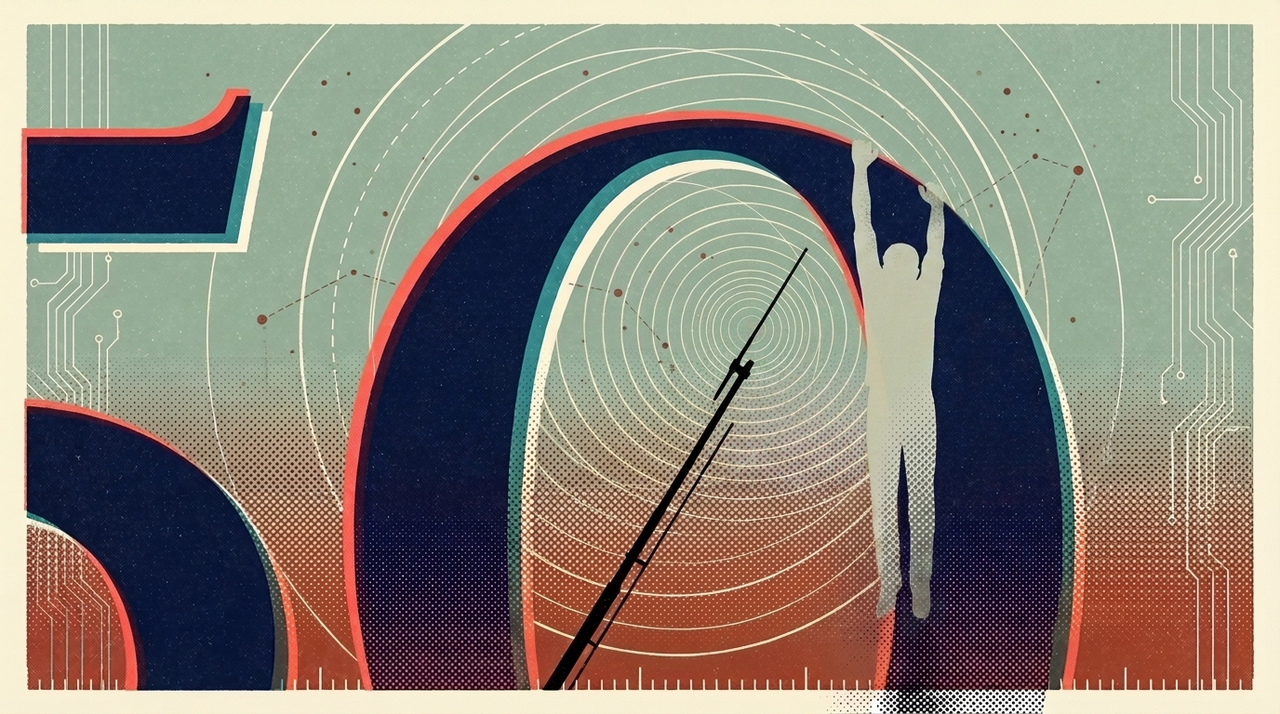
Destabilised, I lost hold of the roof ridge and slithered after the aerial over the edge. I somehow managed to grab on to the non-too-solid guttering, but the rest of my body was dangling Buster Keaton style, precariously in thin air, with nothing between me and almost certain death five storeys below.
You’re probably familiar with the saying “your life flashes before your eyes”, used so often to describe near-death experiences that it has become a cliché. All I can offer is the version I experienced.
As I hung there, literally in limbo between life and death, I recall some striking and vivid things. First, and perhaps most surprising, I felt absolutely no fear, only calm mental clarity. I had a sense that time had stretched enormously. It wasn’t so much life flashing in front of my eyes like a film reel on fast forward, more an IMAX-style panoramic sweep of memories.
I saw myself labouring up the final pitch before the summit of Mont Blanc, exhausted and deeply altitude sick but knowing I would make it. I was riding pillion on a Kawasaki Ninja flashing across the Golden Gate Bridge through a pink dawn mist. I felt the human energy flowing from the dance floor as I nervously warmed up for Carl Cox at the infamous Marcus Garvey Ballroom, my hands shaking so much I could barely put the needle on a record. I was a child poking my feet into the warm powdery coral sand of a Bermudian beach, my back propped against our huge old dog.
All this was accompanied by astoundingly beautiful, otherworldly music of a kind I’ve never been able to describe adequately and that does not exist in this world. I can still retrieve tiny fragments from memory, and I hope to hear it again someday.
But this imagery was simultaneously accompanied by other less serene aspects. I relived several emotionally charged situations from the perspectives of others negatively affected by my actions. I experienced the horrible way I broke up with an old girlfriend, feeling it exactly as she felt it, with full emotional force and pain. It was as if my perspective had become hers.
Perhaps this was some moral reckoning. It certainly baked itself into a human operating system that was a little underdeveloped at the time. “Be kind and think how your actions will affect others”. I don’t know how those words solidified, but they’ve stayed with me ever since. I do my best to remember them.
I have no way of knowing the actual duration of this fugue state. It can’t have been long in real time. The biological adrenaline eventually kicked in, and somehow, after several attempts and with my strength nearly gone, I managed to hook a leg over the gutter and crawl feebly to safety.
I even made my date more or less on time. As I took my seat at the table, a look of shock and concern crossed her face, “Are you ok? You’re a very strange colour”. I excused myself and went to the bathroom. The face looking back at me in the mirror was a spectral, etiolated grey-green of deep physical shock.
Eventually, internet streaming made FM pirate radio stations obsolete. Their role had been to play the underground music you couldn’t hear anywhere else, because the airwaves were so rigidly controlled. Now you could hear whatever you wanted anywhere, anytime. Technology improved and times changed. So it goes.
When you turn 50, there’s the classic version of midlife: panic at the thought that more than half of your life is gone, at having reached the actuarial midpoint. Motorbikes and significantly younger wives sometimes follow.
Twice I’ve come about as close as it is possible to death, so the years since have always seemed like a kind of surplus. Not borrowed time exactly, but a different relationship with it. Being fifty feels like a point on a line that might not have been there at all.
I was born in the mid-1970s, which puts me in the narrow cohort who had a fully analogue childhood and an exponentially digital adulthood. I learned to read from books, to navigate around London with an A-Z on the passenger seat, and listened to music on vinyl and cassette tapes.
My first online connection was via an acoustic coupler, where a loud cough was enough to disrupt it. My university essays were handwritten. Then, as I joined the workforce, it reorganised itself around silicon (although my first job didn’t initially have email, which boggles the minds of anyone under 20 and always elicits the question “what did you do!?”). I reorganised alongside it, and I found I loved it.
AI is now dissolving much of what I’ve spent my career doing. It is said there’s a double exponential at work, both in financial investment and in the number of smart people entering AI research. If Covid taught us anything, it is that we don’t understand the power of single exponentials, let alone double ones. If exponentials are slowly, slowly; all at once, maybe double exponentials are faster, faster; unimaginable change. Either way, great upheaval is coming much more quickly than we seem prepared for.
I am not complacent, but I have already watched a settled world get replaced by a faster and different one before, twice in fact. The web arrived and changed what information was, where it lived, upending power structures and business models. The smartphone arrived and changed what a computer was, where it was used and our degree of connectedness (for good and ill). AI is already orders of magnitude more consequential, and it has barely got started. It will not be easy; history has shown us that powerful technology enables the full spectrum of humanity, from its very best to its most utterly evil.
My half-century arrives at precisely the moment of maximum disruption to everything I’ve previously learnt and built. We are dangling over the edge of something powerful, strange and uncertain. But I’ve been there before and felt no fear.
I am a partner in Better than Good. We help smaller companies build tools and processes using machine learning and artificial intelligence that make lasting improvements to their operations. Talk to us today: https://betterthangood.xyz/contact