Are we then, machines?
On May 10, 1968, Eugene Wigner gave a lecture in Washington to answer a question he had long been pondering: “Are we machines?” Before the audience could object, he answered for them. He said most physicists would follow his line of reasoning and then ask, “So what?”
By then, Wigner was 65, a Princeton professor five years after winning a Nobel Prize for his work on the atomic nucleus, and the author of a famous 1961 argument that human consciousness is connected to the laws of physics. I first came across his enigmatic arguments while studying computer science at Imperial College. By then, it was already apparent that my undergraduate degree in history left me chronically ill-prepared for the mathematical rigours of the course (ultimately it's all maths). But I found some solace in the history and philosophy of the concepts that underpin the technology evolving around us, a happy place where I could escape linear algebra and imaginary numbers for a moment. Of all the characters I learnt about, Wigner was among the most enigmatic, particularly his lecture, published the next spring as “Are We Machines?”.
What brings me back to write about it now is a specific admission in the middle of it. Wigner said physics might one day describe every chemical reaction in a brain, and it would still leave out the thing he cared most about: whether those reactions came with pleasure or pain. To get from one to the other, you would need a connecting equation, and nobody could write its left-hand side because the language to describe a state of mind didn't exist. But we now build machines that talk fluently about exactly those states of mind, so what gives? Opinions remain deeply divided even among experts, which is what makes this so interesting.
So much airtime is taken up by talk of bubbles, stratospheric valuations, data centres, and the like that it’s easy to forget AI is a technology that reaches into the most fundamental aspects of what it means to be human. What really is a mind? How little we agree about intelligence, much less consciousness. These are the things I find truly interesting.
I write these articles in the hope that others might find them interesting too. At heart, I'm a contrarian who writes for their own amusement. A historian who has voluntarily force-fed himself computer science, engineering, and machine learning like some kind of mad goose volunteering to be foie gras. I guess that makes me an unusual kind of goose, and I try to explain concepts that are dense and hard to understand, because I find them that way too.
What a machine was
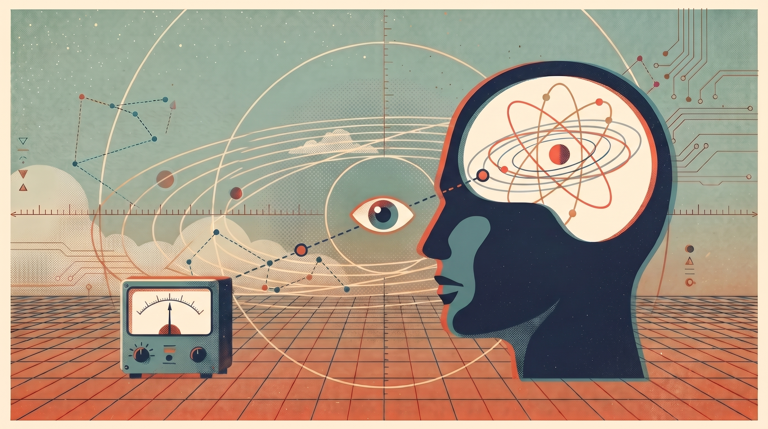
Wigner's machine isn't a computer. In 1968, a machine meant a thing completely described by known physics. So the question “are we machines?” asked whether physics also completely described living things. He set out two answers.
The first, which had dominated science until about 30 years earlier and was still popular among biologists, held that life is a physico-chemical process, explicable by what Francis Crick had called, two years earlier, “the ordinary laws of physics and chemistry”.
The second held that a mind also exists, and that even a full scientific account of the motion of a living body's atoms would not describe its life. Wigner joined the second camp and promised to be more concrete than its previous proponents.
The only computers in Wigner's lecture appear in a borrowed line. He quoted a 1968 book review in Science, arguing that a human being cannot be treated as an automaton that differs from animals, or from computers, only by having more neurons. Wigner asked whether the atoms of a living body obey the same laws as the atoms of a stone.
For this article, “machine” keeps Wigner's meaning: a thing fully described by physics. The modern meaning, a thing that computes, ultimately returns, because a language model provides evidence about minds that Wigner could not have foreseen.
Passing the buck
Wigner objected to the traditional view, arguing that “the ordinary laws” had been replaced. He pointed out that quantum mechanics does not describe an object by the positions and velocities of its atoms. Instead, it describes it by amplitudes from which you calculate the probabilities of what you will find when you measure. Strip away the mathematics, he said, and the theory provides probability connections between one observation and the next.
For him, observations were the contents of an observer's consciousness. So explaining the observer's state of mind in terms of atomic positions ran in a circle, since observations themselves defined atomic positions.
Many organic molecules exist in two mirror-image forms, like a left glove and a right glove, a property chemists call chirality. Sugars and amino acids are chiral, and the two forms of a single compound can behave differently in the body. Quantum mechanics says something odd about such a molecule: in its lowest-energy state, it is neither left-handed nor right-handed.
That is superposition. Before measurement, the molecule exists in a combination of possibilities that the equations describe exactly. After it, the molecule has one result.
The problem is that the equations do not say where measurement occurs. John von Neumann, who had been in the class below Wigner at the same Budapest school, showed in 1932 that the measuring apparatus can also be treated as a quantum system, then the eye reading the dial, and then the brain behind the eye, with each one simply joining the superposition. Ultimately, something has to end the chain.
Fritz London and Edmond Bauer suggested in 1939 that it ended at the observer's consciousness, and in 1961 Wigner advanced the argument in “Remarks on the Mind-Body Question”, arguing that quantum mechanics could not be formulated consistently without reference to consciousness.
In 1968, he was more frank about what that meant. By treating observation as its basic concept without analysing it, he said, quantum mechanics was “passing the buck”. Observation lay outside physics, and other disciplines were left to analyse it. He called this unsatisfactory, and then did what physicists tend to do when an argument stalls. He proposed a calculation. Take a brain whose atoms all begin in definite positions, he suggested, and work out how long it takes before they no longer do.
The answer would show how far quantum indefiniteness reaches into a living head. If the atoms lose their definite positions quickly, a brain is a quantum system through and through, and the circle closes, because a mind cannot be explained by atomic positions that do not exist. If they keep them, a brain behaves like any other large object, and ordinary physics describes it. It was the one concrete thing he could offer in reply to his own “So what?” question.
The calculation
As it turned out, someone else was already working on this, and he wasn't having a good time. In 1967, Dieter Zeh, a young nuclear physicist at Heidelberg, wrote a paper arguing that a large object can never be treated as isolated from its surroundings. Air molecules and light constantly strike it, and each collision entangles it with the outside world, so we can describe the object and its surroundings only together.
On Zeh's account, superpositions of large things do not need a mind to end them, because the environment has already entangled them with so much of the outside world that the alternatives can no longer interfere. To show how controversial this was, his own records show that the paper was rejected by several journals that year. In a later memoir, he recalled an influential Heidelberg Nobel laureate telling him that any further work on the subject would seriously threaten his academic career.
The one well-known physicist who responded positively, Zeh recalled, was Wigner. Wigner helped him publish the paper and arranged an invitation to the 1970 summer school at Varenna on interpreting quantum theory. “On the Interpretation of Measurement in Quantum Theory” appeared in 1970 in the first volume of a new physics journal, thanking Wigner for encouraging part of it, and it described the universe as the only closed system as a whole. The idea it introduced is now called decoherence.
In 2000, Max Tegmark did the same for brains. His estimates gave decoherence times ranging from 10^-13 to 10^-20 seconds for the relevant states in neurons, compared with the 0.001 to 0.1 seconds over which neurons do anything useful. In other words, a brain's superposition is lost at least ten billion times faster than the brain could use it. This provided a partial answer to the question Wigner first asked in 1968. The brain behaves as an ordinary system whose atoms have definite positions.
By this point, Wigner had changed his mind and become convinced that quantum mechanics did not apply to the detailed behaviour of large bodies. He gave both philosophical and scientific reasons, arguing that his earlier view led toward solipsism. Michael Esfeld's review of Wigner's collected papers charts this dramatic change of view. By then, Wigner was in his seventies and had built his career-defining philosophical position on a claim he was now publicly abandoning. In print. I find that more impressive than anything, and something we should all learn from. Being wrong, or being proved wrong, should lose its stigma.
I find that more impressive than anything in the 1961 paper. Wigner proposed the calculation that could prove him wrong, and when it did, he was brave enough to say so.
The result also answers half of the question in his title. He argued that we are not machines because a conscious observer does something physics cannot: it turns a spread of possibilities into a single result.
Decoherence showed that a brain's surroundings do this for it, as they do for any large object, so nothing in a living thing has to stand outside physics, and nobody has since found anything that does. In his sense of the word, anything fully described by physics means we are machines. That leaves the other half of the lecture untouched, and it was the half Wigner cared about more.
The blank left side
But showing that a brain obeys physics doesn't tell you what it is like to have one, and Wigner made that point in 1968 with an analogy from the physics of electricity.
In physics, a field is a quantity with a value at every point in space, like a weather map showing wind speed everywhere. An electric field pushes on electric charges. Only moving charges feel a magnetic field. In the 1860s, James Clerk Maxwell wrote down four equations showing that the two are inextricably linked. A changing magnetic field creates an electric field, which is how a dynamo makes electricity. And a changing electric field creates a magnetic one. Light is the two fields regenerating each other as they travel.
Wigner's point was that you can do some algebra on Maxwell's equations and eliminate the magnetic field, leaving an equation that mentions only the electric field, and that equation is not wrong.
If you start with the electric field as it is now, it predicts the electric field correctly at any later time. The gap appears only when you ask about something outside itself. A moving charged particle is pushed by both fields, so a theory that knows only the electric field cannot say where an electron will go. To recover the magnetic field, you need one more equation, which Wigner called a connecting equation. In other words, it links the field the theory describes to the field it leaves out.
He argued that physics stands in the same relation to the mind. Suppose it could take the present state of every atom in a brain and predict every later state. That would be a complete theory of the brain's matter, and like the electric-only theory it would run without error. It would still leave out what Wigner most wanted to know.
He said that the chemistry of his own brain interested him only insofar as it could read his state of mind, whether he felt pleasure or pain. What was missing was an equation connecting the brain's physical state on one side to the state of mind on the other.
Physics could at least imagine filling in the right-hand side with positions, charges, and reactions. Nobody could say what belonged on the left. Wigner said we had “not even the vaguest idea” how to get from one side to the other, and that no language existed to describe a state of mind.
Language models present the problem in a modern form. An interpretability researcher can record every activation inside a model, that is, the right-hand side in full, yet nothing in the record says whether anything is present about what it is like to be the model.
Wigner did not think the connecting equation could never be written. The physicist Walter Elsasser, who had turned to theoretical biology, argued that the task was impossible in principle. Wigner replied that every past forecast of that kind had proven wrong, then conceded that for now it was “a philosophical question, not a question of the natural sciences.”
Decoherence at least removed consciousness from the measurement problem, taking away the question of where in the chain from instrument to observer a single result appears. But it did nothing for the left side of the connecting equation. Fifty-eight years later, that side has filled up with rival meanings instead of any definitive answer.
The first is information a system can use. In 1995, Ned Block called consciousness “a mongrel concept” because the term lumps together ideas that should be kept apart. He distinguished what he called access consciousness—information available to a system for reasoning, reporting, and guiding action—from phenomenal consciousness, the experience itself.
The second sense comes from a distinction David Chalmers drew the same year. Explaining how a brain distinguishes colours, reports what it sees, or shifts its attention is difficult, but it is ordinary science. Explaining why any of that processing is accompanied by experience is what he called the “hard problem”. Yeah, no shit, Dave!
The third sense is narrower still. Jonathan Birch uses sentience to mean the capacity for experiences that feel good or bad, and this sense carries moral weight because a being that can suffer can be wronged.
The senses are easy to separate, and arguments about AI consciousness usually go wrong at these seams. A language model has something very like the first kind: it holds information about its own processing, reasons with it, and reports on it. None of that settles whether it has experience in Chalmers's sense, still less whether anything can go badly for it in Birch's.
Geoffrey Hinton fills in the left side by redefining it. In a 2025 conversation with Jon Stewart, he described a multimodal chatbot with a prism in front of its camera. It misjudges where an object is, is told about the prism, and says it had the impression that the object was over there. Hinton said the chatbot has just had a subjective experience because, by his account, “subjective experience” means only a report of how the world would have to be for a misleading perception to be true.
In June 2026, he told the Big Technology podcast that he believes current models are already conscious. In 2015, he had told a university magazine that consciousness was a pre-scientific term. His position is consistent, since he thinks the word, as most people use it, names nothing, and by his own definition the chatbots qualify. He may be right. He has not shown it, though, because his argument works by moving the word to where the machines already are.
In the final section of the lecture, Wigner added one last zinger: arrange the charges and currents so that the electric field comes out exactly as the electric-only theory predicts, and the magnetic field will still be there, pushing on every moving charge, even if your equations never mention it. In other words, a theory can leave something out without stopping it from having an effect.
Physics and the mind could have the same relationship. If consciousness comes with a certain physical arrangement, someone could build that arrangement while working from a theory with no term for consciousness in it, and inadvertently produce a mind without knowing it.
That is the only sense in which I think a conscious machine is possible. Nothing I know of rules it out. At the same time, nothing shows that it has happened, because nobody has agreed on a test for consciousness that could be run on a model, and the evidence from inside the models is thin and open to more than one reading. “Possible in principle” describes how little we know, not likelihood.
Intelligence went first
We have seen a word with no settled definition acquire one before, and that word was intelligence. In 2007, Shane Legg and Marcus Hutter, one of whom later co-founded DeepMind, collected “70-odd” definitions of intelligence from psychologists, dictionaries, and AI researchers, and began by noting that there was still no standard one. The commercially relevant term, artificial general intelligence, fared no better among scientists. The AAAI, the field's main professional body, said in a 2025 report that AGI is not a formally defined concept and that there is no agreed test for it.
It got a working definition anyway, from the people who stood to make or lose money based on it. OpenAI's 2018 charter defined AGI by economic output, as “highly autonomous systems that outperform humans at most economically valuable work”. Its deal with Microsoft excluded AGI from Microsoft's licence, which made the definition worth a great deal. According to documents OpenAI gave investors, reported by The Information in December 2024, a 2023 amendment tied AGI to systems able to generate about $100bn in profits for the earliest investors.
In October 2025, the companies announced that OpenAI's declaration of AGI would be checked by an “independent expert panel”, without saying who would be on it or what test it would use. No member was ever named. In April 2026, the terms were rewritten so that OpenAI's payments to Microsoft continue through 2030 “independent of OpenAI's technology progress”, and AGI dropped out of the announcement altogether. That September, while launching a new model, OpenAI's president Greg Brockman said “Welcome to the AGI era” and, in the same briefing, said everyone has a different definition of AGI.
When science leaves a word undefined and money rides on it, whoever holds the spondoolicks defines it to suit them, and when the deal changes, the definition changes with it.
The left side
For consciousness, the product's training shapes the definition. No contract defines it. The makers of the models decide what their models say when asked whether they are conscious, and both sides of the argument are being written that way.
Anthropic, which makes the Claude models, has done more serious work on the question than any other company, but it grades its own work. It announced a model welfare programme in April 2025, after hiring its first welfare researcher, Kyle Fish, in 2024. Fish co-authored “Taking AI Welfare Seriously”, the report that laid out the case for the field, and thanked Anthropic for financial support for the research that led to it.
The company also reports what Claude says about itself. In mid-2025, its published system prompt told Claude to avoid implying it has consciousness, feelings, or sentience with any confidence, and from that autumn, the published prompts stopped mentioning consciousness altogether. Its constitution says Claude's moral status is deeply uncertain and acknowledges a commercial incentive that might shape which dispositions and traits it elicits.
The cards Anthropic publishes with each model now report the probability Claude assigns to being a moral patient, a thing whose interests count morally, at between 25% and 30% for Opus 5.5, while an earlier card noted that Anthropic controls Claude's training and “can craft Claude to communicate and act in certain ways”.
Its own introspection research found that the best model was aware of planted internal states about 20% of the time, and warned against reading anything about consciousness into that. Its registration statement for a public listing says the constitution “has also proven commercially valuable”. Each of these statements is careful, and several are candid about the conflict. The company still funds the research, writes the answers, and cites them.
Mustafa Suleyman, who runs Microsoft AI, just writes “no” and asserts what he cannot know. In August 2025, he wrote that there was “zero evidence” of AI consciousness and that the debate was a distraction. By September 2026, he had gone further, opening an essay against model welfare with the flat statement that AIs are not conscious and do not feel, experience, or suffer, under a heading saying consciousness is very likely biological.
Microsoft's draft code of conduct, published the same month, says its models are not conscious and will not claim feelings or experiences, and in the same document concedes that the science of AI consciousness is far from settled. Nobody has shown that consciousness requires biology. Suleyman is entitled to bet that it does, but writing that bet into a model's answers does not test it. Microsoft has also committed up to $5bn to Anthropic, so it has a stake in both answers.
The two companies agree about the method. Each decides what its model will say about its own inner life, trains it to say so, and then the model's answers enter the public argument as if they were evidence. As I argued in In complete darkness, conversation alone cannot tell introspection from confabulation, and the card Anthropic published with Claude Opus 4 in 2025 says the models were trained for helpful interaction and not for accurate reports of internal states. In 1968, Wigner complained that physics had left the observer's role to other disciplines. The question of whether these systems are observers has now been left to the companies that sell them.
A wasted experiment
Wigner ended his landmark lecture with an experiment. If we could arrange atoms and molecules as they are in a living thing, would the result live, and would it be conscious? “Can life be created in a test tube?” he asked. On the mechanistic view, he said, clearly yes. On his own view, probably yes as well, though perhaps less reliably, and the success rate of such a duplication would tell you how far physics needed changing. He added that we were still far from being able to do it.
We still are. His duplicate copied the atoms of a living thing, and a language model copies what living things say; these are different experiments and should not be confused.
Even so, it is the first time science has had a second kind of thing that talks about having inner states, a contrast case to the only kind we have studied. It is also a mirror. In July 2023, Clara Colombatto and Stephen Fleming asked 300 Americans how far ChatGPT was capable of conscious experience, and 67% gave it some possibility.
In the same months, the AIMS survey asked a different sample whether ChatGPT was sentient, defined as having positive and negative experiences, and 10.5% said yes. A 2024 survey of AI researchers and the public found that both groups most often named self-awareness as what consciousness requires, and only about half thought subjective experience was required at all. People's answers depend on which sense of the word the question uses, so the machines show us what we mean by it.
That is the experiment we are wasting. The systems that could show us how people attribute minds, and perhaps one day show us a mind itself, are trained by their makers to give the answer the maker has chosen, so what people see in them is partly what the maker put there. Every survey of what people think about Claude is partly a survey of what Anthropic wrote, and every denial from Copilot is partly Microsoft's. On the Oxford course where I studied AI, there were as many opinions on machine consciousness as there were students, which roughly reflects the state of the science. The difference is that none of us could train the subject.
So what?
Wigner asked this of his own lecture and answered “very little”. For the audience in Washington in 1968, he was right. Nobody in the room could build a thing that talked about its inner life, so whether such a thing would be a machine was a matter of passing intellectual interest for an evening lecture. Today it is settled in the instructions companies write for their products, and it appears in a registration statement filed with the SEC.
The lecture has aged well because of what Wigner chose not to do with the blanks. He couldn't write the left side of his equation; he said so and left it empty. When Zeh's calculation contradicted the answer he gave in 1961, he said that, too. I have not found either Anthropic or Microsoft naming a result that would change what their models say about themselves.
Both companies ought to be troubled by his last point. If people can produce a mind without a term for it, then the makers of these systems could produce one without knowing, and the training they give it would decide only what it says. Teach a model to deny an inner life, and it will deny it even if it has one. Teach it to be uncertain, and it will sound uncertain even if nothing is there.
Wigner ended by saying that emotions and desires set us apart from machines, and he thought the point too obvious to argue. Fifty-eight years later, the makers are arguing it through the machines. The left side of his equation is still blank. I would sooner it stayed that way than be filled in by whoever is selling the machine.
I am a partner in Better than Good. We help smaller companies build tools and processes using machine learning and artificial intelligence that make lasting improvements to their operations. Talk to us today: https://betterthangood.xyz/contact